

Discover what Red Eléctrica is, what we do, and why we are the backbone of the electricity system in Spain and the ecological transition.






Grid Access
Red Eléctrica publishes the demand access capacity map by consumption type
Available on Red Eléctrica's website from today, the map allows users to consult information on the status of access to the transmission grid for demand facilities, classified by consumption type and geographical location.
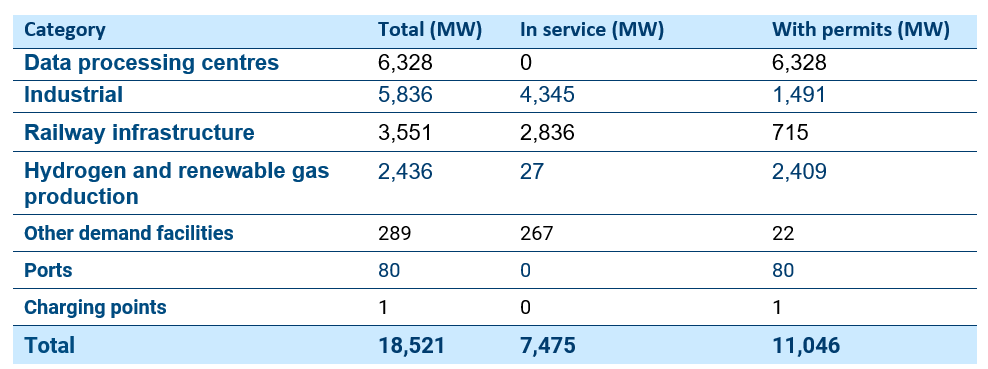
Data processing centres account for the largest volume of capacity already granted to connect to the transmission grid, representing 34% of the total, followed by industrial supplies and railway power supply.
This is additional information that Red Eléctrica provides voluntarily, in a format that facilitates a more comprehensive and transparent view of the status and management of access capacity.
Red Eléctrica is also publishing the updated values for available demand capacity on the transmission grid, following the first scenario update carried out in accordance with the schedule established by the CNMC.
01/10/2026

Red Eléctrica, in its capacity as the system operator, today published on its website the map showing the status of demand access and connection permit applications for the transmission grid, as well as the capacity granted and the capacity being processed.
Through various navigation levels, the new tool allows users to consult the breakdown by consumption type and the geographical location of the 18.52 GW of access granted on the transmission grid. Of this total, 11.05 GW corresponds to demand facilities that have not yet been commissioned. The data do not include information regarding applications to the distribution networks.
This new map developed by Red Eléctrica incorporates information broken down into seven consumption categories. At a national level, data processing centres account for the highest volume of allocated access, with 6,329 MW granted (34.2% of the total), although none have yet been commissioned. They are followed by industrial facilities, with 5,838 MW of awarded capacity, of which 4,346 MW have already been put into service (taking into account both capacity expansions and new supplies combined); railway infrastructure, which represent 19.2% of the total capacity granted; and hydrogen and renewable gas production projects, with 13.2%. Below is the breakdown by category, including the total awarded volume, the capacity already commissioned, and the capacity that, despite having the corresponding permits, remains unconnected to the grid.
View the map with the status of applications here.
Furthermore, in today's publication, Red Eléctrica has updated the demand access capacities on the transmission grid following the scenario update in accordance with the provisions set out by the CNMC in its resolution of 1 December 2025. The new scenario takes into account the current evolution of generation, with changes particularly in photovoltaic generation. Firm demand access capacity increased at 204 nodes of the transmission grid, remained unchanged at 658, and decreased at 75 nodes, meaning there is available capacity ready to be granted at over 35% of the transmission grid nodes. This capacity may be allocated following the general order for processing applications or through the competitive bidding mechanisms established by current regulations.
View information on available and occupied demand access capacity here.
Access capacities for storage in demand mode have also been updated in line with this new scenario. As has been the case to date, these capacity values treat storage as flexible demand for the electricity system.
A continuing exercise in transparency
This publication represents a significant step forward in terms of transparency by providing users with relevant information on access capacity values at transmission grid nodes, and the status of demand permits already granted for connection to the transmission grid.
This is additional information that Red Eléctrica provides on a voluntary basis to offer a more comprehensive and transparent view of the status and management of access capacity on the transmission grid.
Download