
Discover what Red Eléctrica is, what we do, and why we are the backbone of the electricity system in Spain and the ecological transition.





Commitment to the Campo de Gibraltar region
Red Eléctrica partners with artisanal fishermen in La Línea to implement improvements at La Atunara Port
- Planned initiatives include the installation of a mollusc purification plant and a processing facility for flying fish, along with a photovoltaic plant that will improve the energy efficiency of their operations.
- The €141,000 agreement reflects the commitment of Red Eléctrica and Redeia to the region, in line with their Sustainability Commitment.
- The collaboration agreement is part of the electricity interconnection project between the Spanish Peninsula and Ceuta, included in the current Electricity Transmission Grid Plan.
04/09/2025
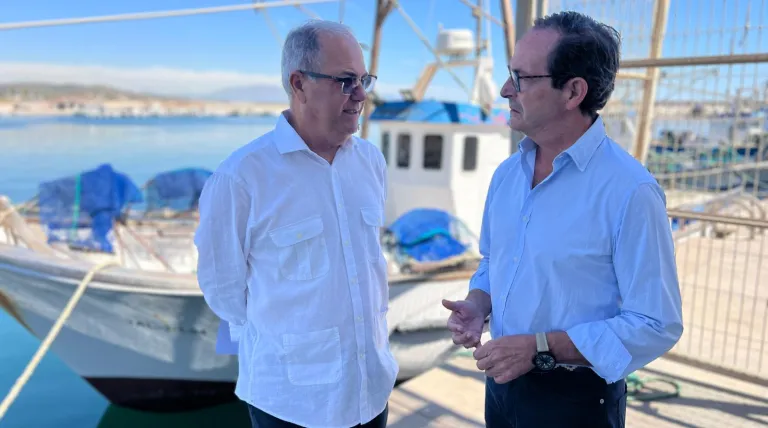
Red Eléctrica and the Organisation of Artisanal Fisheries Producers of the Conil Fish Market (OPP72) signed a cooperation agreement this Thursday. Through this partnership, the company will promote a set of production, competitiveness, and energy-saving improvements at the La Atunara Port in La Línea de la Concepción (Cádiz). The agreement is part of the electricity interconnection project between the Spanish Peninsula and Ceuta, included in the current Electricity Transmission Grid Plan approved by the Council of Ministers in March 2022.
The signing ceremony was attended by Nicolás Fernández, manager of the Organisation of Artisanal Fisheries Producers of the Conil Fish Market, and Jorge Jiménez, Redeia’s manager in Andalusia.
Under this partnership, Red Eléctrica will contribute €141,000 to fund improvements to the mollusc purification centre and the flying fish processing facility. In addition, a 15 kW photovoltaic plant will be installed to reduce energy costs. A new, more efficient fuel supply system for boats will also be implemented, and an information point will be opened in the fish market itself.
‘Engaging with all our stakeholders, and in this case in particular with the artisanal fishermen of La Atunara, is core to Red Eléctrica and its parent company Redeia’s mission to create positive social impact, especially in the local communities where we develop our projects,’ said Redeia’s manager in Andalusia, Jorge Jiménez, at the signing ceremony. He emphasised the company’s commitment to the region through the creation of shared value with its stakeholders.
The agreement highlights Redeia and its subsidiary Red Eléctrica’s determination to promote projects that foster social development, the preservation of artisanal employment, environmental protection, and efficient energy use. This approach is aligned with the 2030 Sustainability Commitment.
For his part, Nicolás Fernández, manager of the Organisation of Artisanal Fisheries Producers of the Conil Fish Market, explained that ‘for artisanal fishermen, this agreement represents an important boost in addressing the essential needs of our fishermen at La Atunara Port. Partnerships such as this one with Red Eléctrica strengthen the social and economic fabric of fishing families. We look forward to a long-term collaboration on other areas of common interest related to our marine environment and its potential.’
Electricity interconnection between the Spanish Peninsula and Ceuta: a national project
The initiative is part of the electricity interconnection project between the Spanish Peninsula and Ceuta, a national strategic project that will be key to improving quality of life and the Ceuta economy by reducing its reliance on fossil fuels. This move contributes to the decarbonisation of the Strait and advances the ecological transition. It will also bring improvements to the Campo de Gibraltar region by strengthening its electricity infrastructure and increasing its capacity to absorb future residential and industrial energy demand.
On 26 August, a key milestone was reached with the start of laying the first submarine circuit between the Spanish Peninsula and Ceuta. The cable – an advanced technology design with dry insulation and no internal liquids – extends 58 kilometres and is buried under the seabed along a route designed to be sustainable and compatible with other aquaculture and fishing infrastructures in the area. For the same purpose, horizontal directional drilling is used at the landfall points, creating a small tunnel for the cable to run from the coast up to one kilometre offshore. This helps avoid any impact on beaches or fishing activity.
With this agreement, Red Eléctrica reaffirms its commitment to cooperation with the fishing industry. In recent years, the company has been working with the University of Seville to analyse the impact of the invasive algae Rugulopteryx okamurae on fisheries in the Strait.
Downloads