
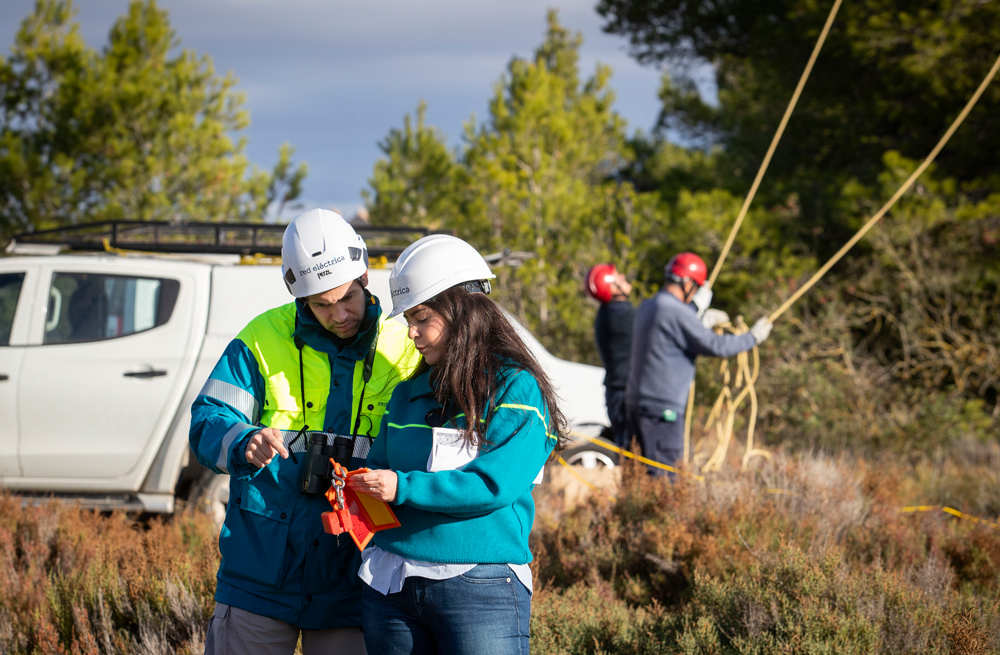
Discover what Red Eléctrica is, what we do, and why we are the backbone of the electricity system in Spain and the ecological transition.




Spain’s demand for electricity falls by 1.4% in October
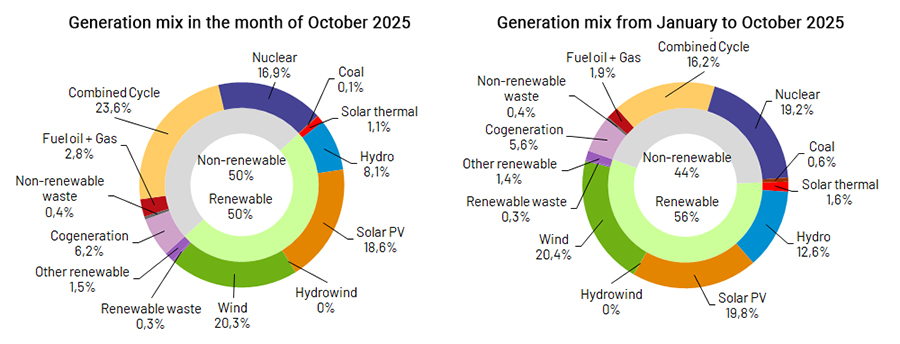
Renewables produced 10,918 GWh in October, accounting for 50% of the total national monthly generation mix.
03/11/2025
National electricity demand fell by 1.4% in October compared to the same month last year, after adjusting for the effects of temperature and working patterns. This represents an estimated gross demand of 20,218 GWh, 0.6% lower than in October 2024.
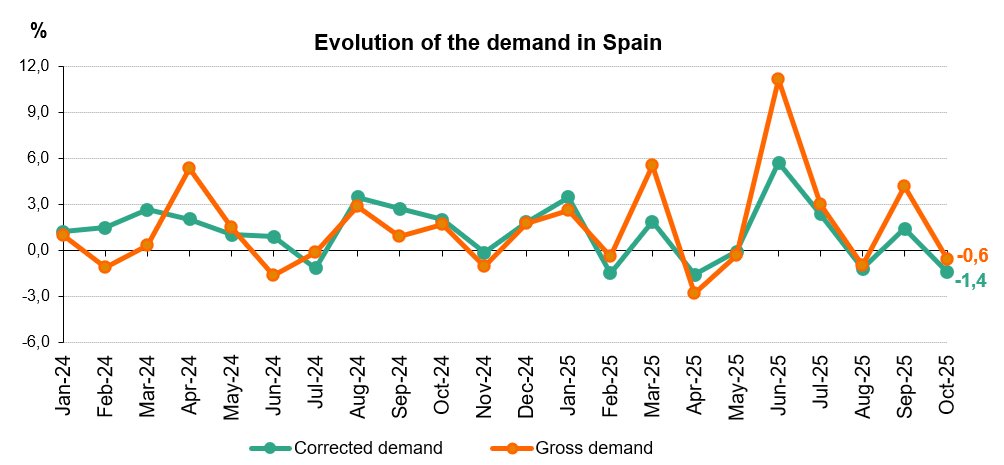
In the aggregate for the year, Spain recorded a demand of 211,825 GWh, 2.1% higher than in the same period of 2024. Once again, after adjusting for the effects of working patterns and temperatures, demand increased by 0.9% compared to the same period of the previous year.
This October, renewables recorded 10,918 GWh, accounting for a 50% share of total electricity generation, according to data available to date. Moreover, this month, 66.9% of electricity generation came from technologies that do not emit CO2 equivalent.
The leading source of generation in October was combined cycle, accounting for 23.6% of the total. Wind power was the second-largest source, generating 4,439 GWh, which accounted for 20.3% of the mix. This was followed by solar photovoltaic, with a monthly electricity generation of 4,065 GWh—45.3% more than in the same period last year—achieving an 18.6% share of the generation mix. Nuclear power was in fourth place with 16.9%.
In October, storage technologies enabled the integration of 805 GWh of electricity into the Spanish electricity system, helping optimise the use of renewable electricity generation. Additionally, 1,270 GWh of electricity were scheduled for export to neighbouring countries.
The electricity system in Islas Baleares and Islas Canarias
In Islas Baleares, electricity demand in October decreased by 0.8% after factoring in the effects of working patterns and temperatures. Monthly gross demand was estimated at 501,832 MWh, marking a 0.5% decrease compared to the previous year.
From January to October 2025, electricity demand in Islas Baleares totalled 5,417,890 MWh, 3.7% higher than in the same period of 2024.
In terms of electricity generation, the combined cycle—which accounted for 68.3% of the energy produced in Islas Baleares—was the leading source this month. Meanwhile, renewable energy generation in Islas Baleares accounted for 12.5% of the total.
Additionally, this October, the submarine link between the Peninsula and Mallorca helped cover 23.8% of Islas Baleares' electricity demand.
Meanwhile, in Islas Canarias, electricity demand rose by 1.5% compared to the same month in 2024, after adjusting for the effects of working patterns and temperatures. This represents an estimated gross demand of 790,284 MWh, marking a 1.6% increase compared to October 2024.
So far in 2025, total demand in Islas Canarias has reached 7,458,928 MWh, which is 0.9% higher than in the same period of the previous year.
In terms of electricity generation in Islas Canarias, the combined cycle was also the leading source in October—with 46.8% of the total. Renewables contributed 15.4% of total electricity generation, providing 121,475 MWh. Wind energy accounted for 85,925 MWh (10.9% of total generation), while solar photovoltaic produced 34,326 MWh (4.3% of total generation).
Downloads