
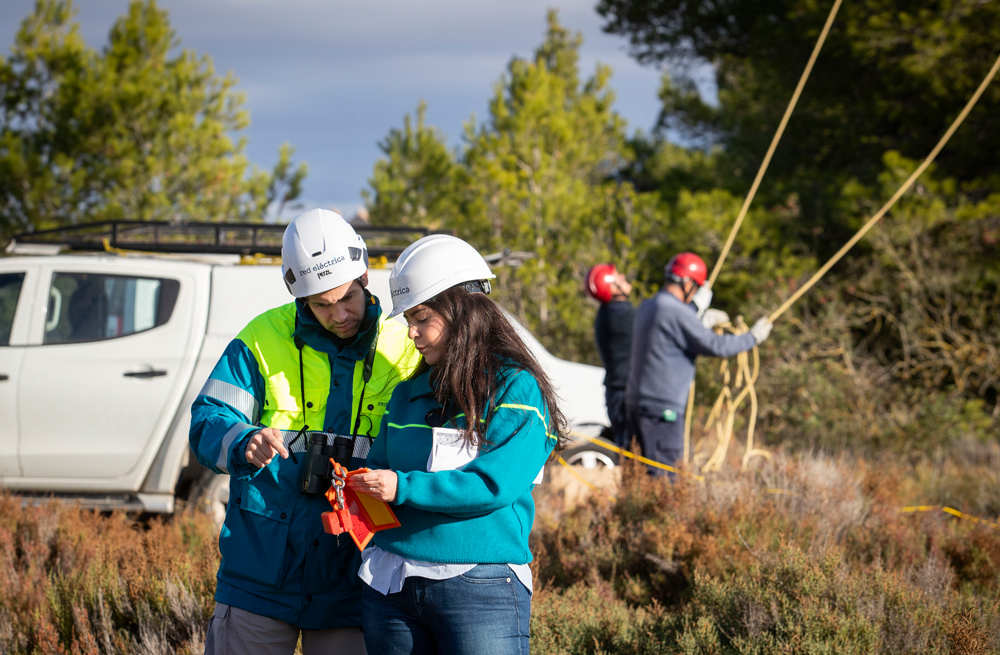
Discover what Red Eléctrica is, what we do, and why we are the backbone of the electricity system in Spain and the ecological transition.




Spain’s demand for electricity falls by 1.7% in August
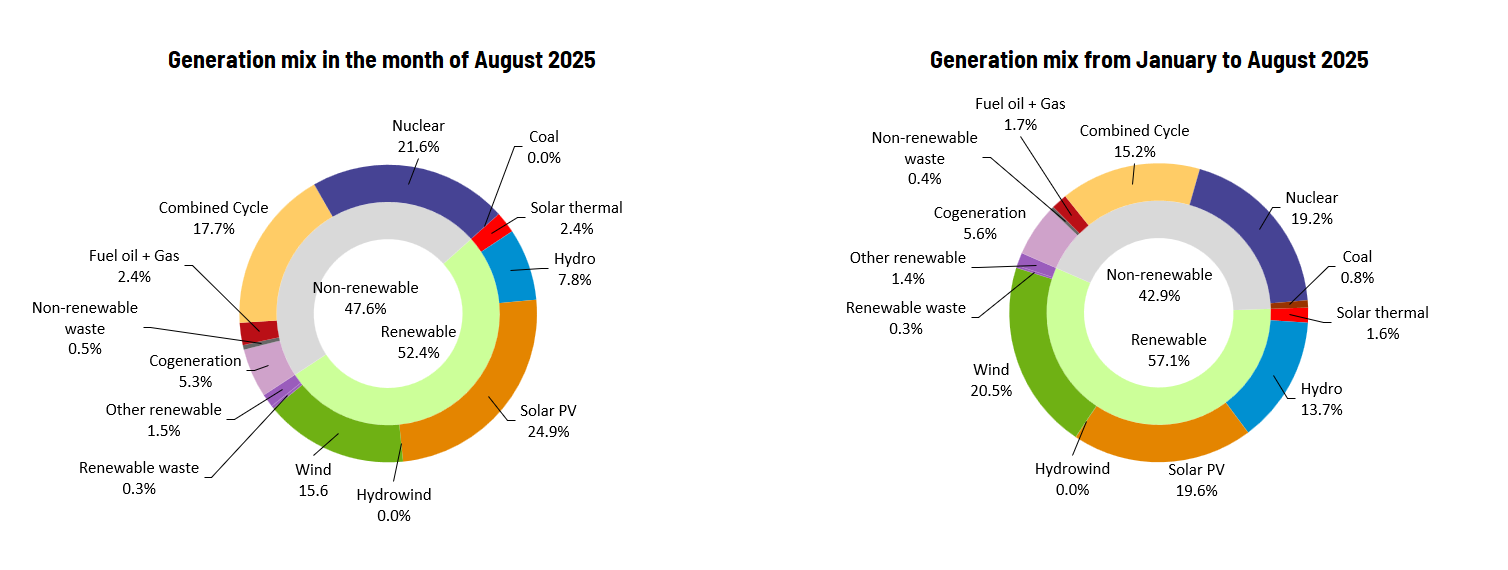
In August, 52.4% of our country's electricity generation was renewable, and 74.1% emitted no equivalent CO2.
Solar photovoltaic provided a quarter of the demand and remains the leading technology in the energy mix for the fourth consecutive month, with electricity generation 8.5% higher compared to August 2024.
02/09/2025
National electricity demand fell by 1.7% in August compared to the same month last year, after adjusting for the effects of temperature and working patterns. This represents an estimated gross demand of 22,128 GWh, 1.5% lower than in August 2024.

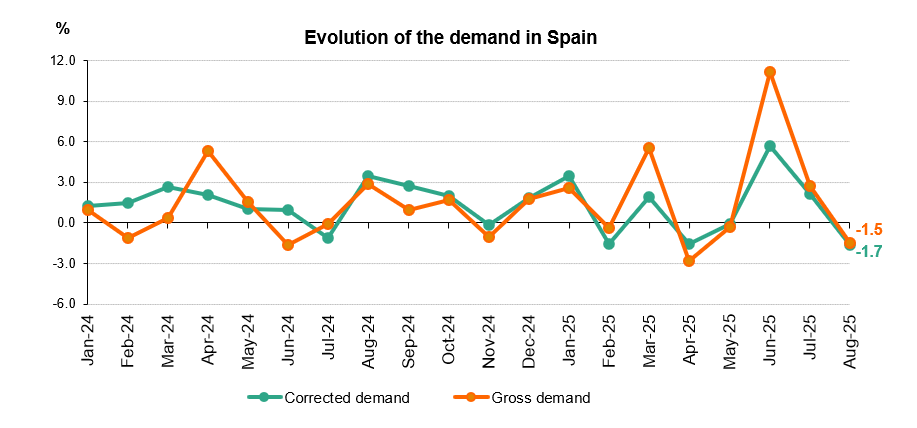
In the first eight months of 2025, Spain recorded a demand of 170,653 GWh, 2.1% more than in the same period of 2024. Once again, after adjusting for the effects of working patterns and temperatures, demand increased by 1.1% compared to the same period of the previous year.
Regarding the share of different technologies, renewables generated 0.7% more in August than in the same month in 2024, with a total of 12,318 GWh. This represented a 52.4% share of total electricity generation, according to the data available today. Moreover, this month, 74.1 % of electricity generation came from technologies that do not emit CO2 equivalent.
Specifically, the leading generation source in August was solar photovoltaic, with electricity generation of 5,847 GWh—an 8.5% increase compared to the same period last year—and accounting for 24.9% of the generation mix. Following are nuclear energy (21.6%), combined cycle (17.7%), and wind power (15.6%).
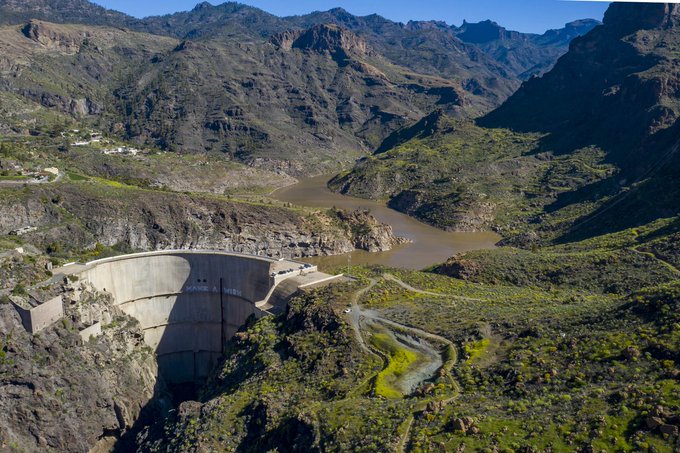
Hydropower increased electricity generation by 1.6% compared to August 2024, reaching 1,839 GWh, which accounts for 7.8% of the total in Spain.
Storage technologies enabled the integration of 877 GWh of electricity into the Spanish electricity system, helping optimise the use of renewable electricity generation. Additionally, 949 GWh of electricity were scheduled for export to neighbouring countries.
The electricity system in the Balearic and Canary Islands
In the Balearic Islands, electricity demand in August declined by 0.6% when adjusting for labour and temperature effects, although gross demand for the month is estimated at 735,539 MWh—0.3% higher than the previous year.
Up to the end of August 2025, electricity demand in the Balearic Islands totalled 4,318,861 MWh, a 3.7% increase compared to the same period last year.
Regarding electricity generation, combined cycle plants accounted for 63.1% of the energy produced in the archipelago, making them the primary source of electricity in the region. Meanwhile, renewable energy generation in the Balearic Islands accounted for 14.2% of the total. Renewable electricity generation in the Balearic Islands grew by 5.2% compared to the same month last year.
Additionally, this August, the submarine link between the Peninsula and Mallorca helped cover 28.3% of the Balearic Islands' electricity demand.
Meanwhile, in the Canary Islands, electricity demand rose by 3.5% compared to the same month in 2024, after adjusting for the effects of working patterns and temperatures. This represents an estimated gross demand of 817,589 MWh, marking a 3.4% increase compared to August 2024.
So far in 2025, total demand in the Canary Islands has reached 5,886,177 MWh, which is 0.3% higher than in the same period of the previous year.
In terms of electricity generation in the Canary Islands, combined cycle, at 44.5% of the total, was also the leading source in August. Renewables contributed 23.5% of total electricity generation, providing 192,359 MWh. Wind energy contributed 148,773 MWh during this month, accounting for 18.2% of the total. Solar photovoltaic generation amounted to 43,586 MWh, representing 5.3% of the total, with a 6.4% increase compared to August 2024.
En el acumulado del año, Canarias ha registrado una demanda total de 5.886.177 MWh, un 0,3 % más que la del mismo periodo del año anterior.
En cuanto a la generación eléctrica en Canarias, el ciclo combinado, con un 44,5 % del total, fue la primera fuente de generación en agosto. Las renovables alcanzaron una cuota del 23,5 % de la producción al generar 192.359 MWh. La aportación eólica durante este mes ha sido de 148.773 MWh, lo que supone un 18,2 % sobre el total. La solar fotovoltaica ha producido 43.586 MWh, que supone un 5,3 % del total, con un aumento 6,4 % respecto a agosto del año 2024.
Descargas