
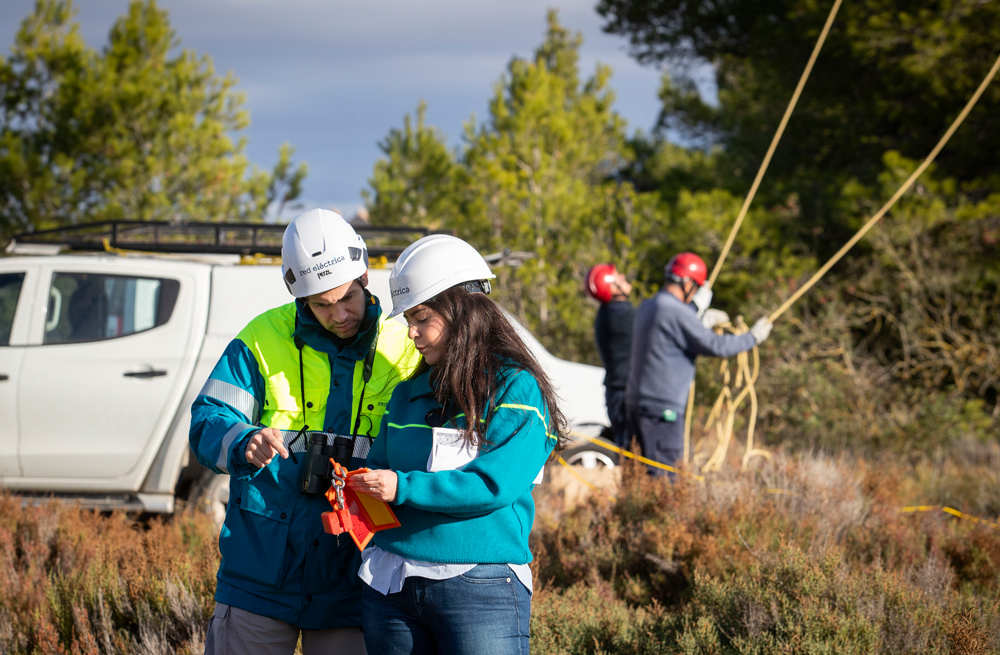
Discover what Red Eléctrica is, what we do, and why we are the backbone of the electricity system in Spain and the ecological transition.




Spain's electricity demand increases by 1.8% in September
- Solar photovoltaic achieves its sixth consecutive month as the leading technology in the Spanish mix with a 26.3% share.
02/10/2026
National electricity demand increased by 1.8% in September compared to the same month last year, after adjusting for working patterns and temperatures. In gross terms, demand reached 22,014 GWh, 5.7% higher than in the same month of 2025.
Also in September, based on available data, it is estimated that self-consumption installations generated around 1,360 GWh.
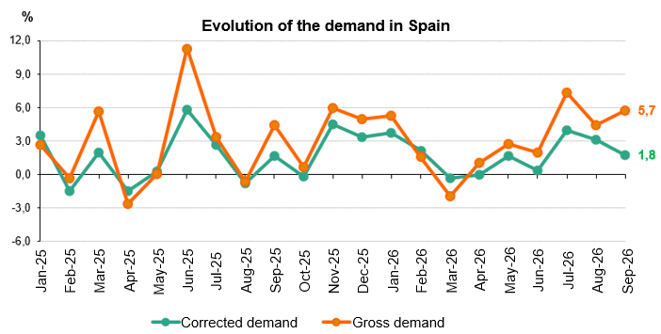
Note: This chart does not include self-consumption data.
In the first nine months of 2026, Spain recorded a total electricity demand of 198,105 GWh, representing an increase of 3.2% compared to the same period of the previous year. Taking working patterns and temperatures into account, this growth stands at 1.8%.
Electricity generation
Renewable technologies increased their contribution by 5.7% this September compared to the same month in 2025, reaching 12,215 GWh and securing a 50.9% share of the total generation structure.
Solar photovoltaic leads generation for the sixth consecutive month with a 26.3% share, achieved by increasing its electricity generation by 25.1% to 6,307 GWh. This is followed by combined cycle, accounting for 20.8%, then nuclear at 20.4%, wind at 14.1%, and hydro with 6.9% of the total.
During the month of September, 71.3% of electricity generation was free from CO2 equivalent emissions, representing a 6.3% increase in zero-emission GWh produced.
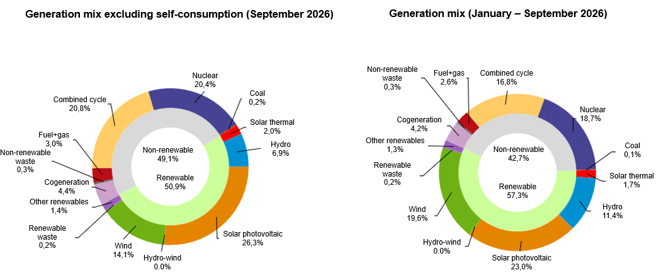
When accounting for electricity generation data from self-consumption installations, the renewable share of the Spanish mix rose to 52.7% in September, according to available estimates.
To promote greater utilisation of renewable generation, a total of 739 GWh was integrated into the grid in September through battery storage and pumped-storage hydro.
The electricity system in Islas Baleares and Canarias
Electricity demand in Islas Baleares increased by 3.7% in September after adjusting for working patterns and temperatures. In gross terms, monthly demand is estimated at 639,696 MWh, 5.8% higher than that recorded during the same month of 2025. In the first nine months of 2026, electricity demand in Islas Baleares stood at 5,251,900 MWh, 6.4% higher than in the same period of the previous year.
Regarding electricity generation, combined cycle, accounting for 63.8% of the energy produced in Islas Baleares, was the leading generation source on the islands this month, followed by solar photovoltaic, which increased its production by 18.1% compared to the previous year and in September was responsible for 11.3%, and gas turbines at 11.1%. Thus, renewable energy grew by 14.6% compared to the same period last year, reaching a share of 14.1% of the total generation in the archipelago.
During this ninth month of the year, the subsea link between the peninsula and Mallorca helped cover 21.2% of electricity demand in Islas Baleares.
Turning to the Canarias archipelago, electricity demand grew by 4.4% compared to the same month in 2025, adjusting for working patterns and temperatures. In gross terms, demand stood at 825,318 MWh, 5.5% higher than in September of the previous year. For the year to date in 2026, Canarias recorded a demand of 6,807,964 MWh, 2% higher than in the same period of 2025.
Lastly, in terms of electricity generation, combined cycle, accounting for 36.7% of the total, was the leading source in Canarias in September, followed by diesel engines at 20.8%, and steam turbines at 18.3%. Wind power follows with a 13.9% share. During September, the share of renewable technologies accounted for 19.4% of the mix.
Download