
Discover what Red Eléctrica is, what we do, and why we are the backbone of the electricity system in Spain and the ecological transition.




Red Eléctrica’s Cecre marks its 20th anniversary
Since its launch, the Renewable Energy Control Centre has integrated electricity equivalent to the consumption of the Spanish Peninsula over the past five years
Launched in 2006, it was the world’s first electricity control centre dedicated exclusively to ensuring the safe integration of renewable energies such as wind and solar power.
The Cecre was made possible by the vision of Red Eléctrica’s teams, who anticipate future needs and apply cutting-edge technology to support the transformation of the electricity system.
The centre has gone from supervising just 450 electricity generation plants in its early years to overseeing more than 4,500 wind and solar facilities today.
15/06/2026
Since it began operations in 2006, Red Eléctrica’s Renewable Energy Control Centre (Cecre) has integrated more than 1,346 TWh of wind power and solar generation, roughly equivalent to the electricity consumption of the Spanish Peninsula over the past five years. Thanks to the Cecre’s contribution, renewable generation as a whole, including hydropower and other technologies, has produced more than 2,031 TWh of green electricity over the last two decades.
This year marks the 20th anniversary of a facility that broke new ground when it was established. It was the world’s first electricity control centre dedicated exclusively to renewable energies and remains an international benchmark today. Its role is to ensure the safe and reliable integration of electricity generated mainly by wind and solar facilities into the Spanish peninsular electricity system.
According to Concha Sánchez, General Director of System Operation, ‘The launch of the Cecre was a strategic decision driven by a group of visionary professionals at Red Eléctrica who recognised the importance of renewable energies and the key role they would soon play, as they do today. Thanks to the hard work and commitment shown over the past two decades, Spain has become a leading force in this field. We are now the second-largest producer of wind and solar power in the EU.’
Before the Cecre was launched, these two renewable technologies accounted for just 8.4% of the peninsular electricity mix in 2005. By 2025, their combined annual share had risen to 42.8%. This growth was key in enabling the system to close last year with renewables accounting for 57.5% of annual electricity generation. When self-consumption electricity generation is also included, the figure rises to 58.5%. So far in 2026 (up to 31 May), renewables have already accounted for 62.3% of the peninsular electricity mix.
Over the past two decades, the Cecre has even reached levels of instantaneous demand coverage of up to 90.5% for solar photovoltaic and 83.6% for wind power in 2026 and 2023 respectively.This remarkable progress has been made possible by a fivefold increase in the volume of wind and solar GWh integrated by the Cecre compared to its early years (2025 data versus figures from twenty years ago).
Source: Red Eléctrica’s Data
Today, thanks to the work of the Renewable energy control centre, Spain now has one of the highest levels of renewable penetration in the European Union. Last year, 96.6% of scheduled market electricity generation was successfully integrated into the Spanish peninsular electricity system, a share that exceeds European regulatory requirements, even after a significant increase in installed renewable capacity. Over the past two decades, 76,002 MW of wind and solar capacity have been installed in the Iberian Peninsula. Together with other renewable technologies, they now account for 73% of total installed capacity in the country.
Monitoring of more than 4,500 generation plants
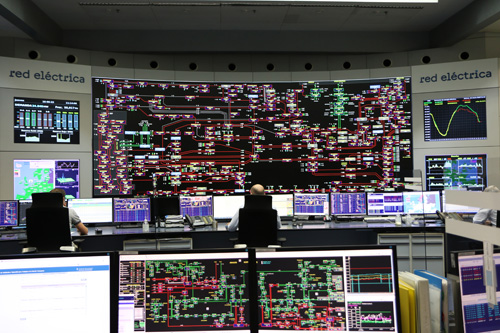
Located alongside Red Eléctrica’s Electricity Control Centre (Cecoel), which is responsible for maintaining the balance between electricity demand and generation at all times, the Cecre manages wind and solar generation (both photovoltaic and solar thermal) in real time. This is a highly complex task due to the considerable variability of renewable sources and their geographical distribution.
Specifically, the Renewable Energy Control Centre receives information every 12 seconds via telemetry. The data comes from more than 4,500 wind and solar installations with a capacity above 1 MW, enabling the system to take full advantage of the Peninsula’s wind and solar resources. In 2006, this figure was fewer than 450 installations.
Thus, the Cecre monitors and controls these plants, allowing it to issue setpoints to adjust electricity generation based on system requirements.
Over these two decades, Red Eléctrica has continued to evolve its capabilities, introducing additional flexibility tools such as the automatic power reduction system (SRAP). With more than 65 GW of enabled capacity (over one third of which is photovoltaic), the SRAP has enabled the integration of more than 6.5 TWh since its commissioning (equivalent to roughly ten days of electricity consumption in Spain). The SRAP improves efficiency by anticipating and resolving potential technical restrictions related to system security criteria, supporting greater renewable penetration through increased utilisation of the transmission grid.
Over this period, the Cecre has enabled the electricity system to harness the flexibility of these technologies through their participation as providers of balancing services. In 2025 alone, 8 TWh were activated.
In recent months, significant progress has also been made in deploying the new voltage control service Operating Procedure 7.4 (P.O. 7.4) through setpoints, with 21 GW of installed capacity already providing the service, including 8 GW from renewables, cogeneration and waste.
Future challenges for this international benchmark
Following the significant progress made in recent years, the Cecre now faces the challenge of continuing to safely integrate renewable energy generation into a system where the energy transition is giving rise to new ways of generating and consuming electricity, such as hybrid systems with storage. ‘The electricity system is not static. Instead, over recent years it has undergone a major transformation which necessarily requires the ongoing adaptation of system operation to new realities, as quickly and efficiently as possible,’ says Concha Sánchez. She adds: ‘This is exactly what we have done with self-consumption, anticipating its development through forecasts and studies that allow us to predict its behaviour and make decisions.’
The success of the Cecre’s creation is reflected in the global interest it has attracted. Since its inception, it has been visited by TSO members of Entso-E and by dozens of countries across five continents, including representatives from the United States, Mexico, Brazil, Argentina, Jordan, China, Japan, South Korea and Australia.
20 years of the Cecre: key figures (Peninsula data):
- In 2005, renewables accounted for 16.5% of total annual generation in the system, compared to 57.5% at the end of 2025.
- Renewable generation in GWh has increased 3.6-fold since 2005, when 41,148 GWh were produced, compared to 148,523 GWh in 2025.
- Solar generation has grown from virtually zero in 2005 to a 20.5% share of total generation in 2025.
- Wind power has also seen strong growth, rising from 8.4% in 2005 to 22.2% in 2025. It was the leading technology in the generation mix in 2013, 2021, 2023, 2024 and 2025.
- Installed renewable capacity in the Iberian Peninsula stood at 26,405 MW in 2006, compared to 105,751 MW at the end of May 2026, reflecting an increase in generation capacity from 37% twenty years ago to 73% today.
- In 2005, the peninsular electricity system had 9,654 MW of wind power capacity, compared to 32,833 MW installed as of May 2026.
As for solar power (photovoltaic and thermal), the increase is even more pronounced, rising from just 43 MW installed when the Cecre was launched to 54,585 MW today (May).