
Discover what Red Eléctrica is, what we do, and why we are the backbone of the electricity system in Spain and the ecological transition.




Spain's demand for electricity remains virtually unchanged in May
- Solar photovoltaic leads the national electricity generation mix for the second consecutive month in May, with a monthly renewable contribution of 60.5%.
- May recorded the highest solar photovoltaic share in history, accounting for 28.5% of the total.
03/06/2026
National electricity demand increased by 0.1% this May compared to the same month last year, after adjusting for working patterns and temperatures. In gross terms, demand reached 19,783 GWh, 1.2% higher than in the same month of 2025. In addition, based on available data, it is estimated that self-consumption installations generated around 1,368 GWh during the month.
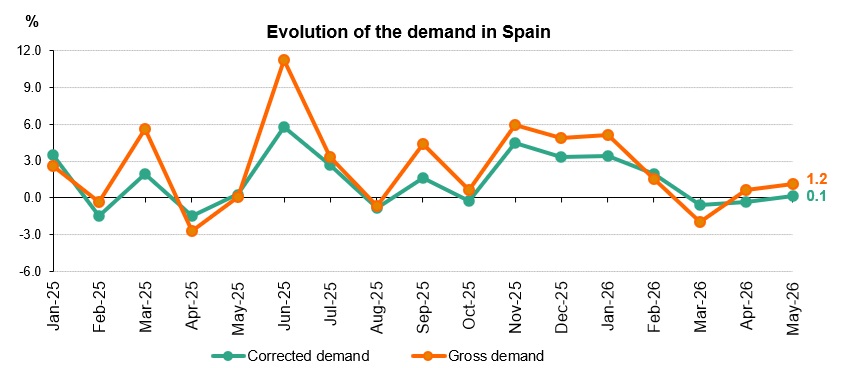
Note: This chart does not include self-consumption data.
In the first five months of 2026, Spain recorded a total electricity demand of 104,801 GWh, representing an increase of 1.4% compared with the same period of the previous year. Taking working patterns and temperatures into account, this growth stands at 1%.
Electricity generation
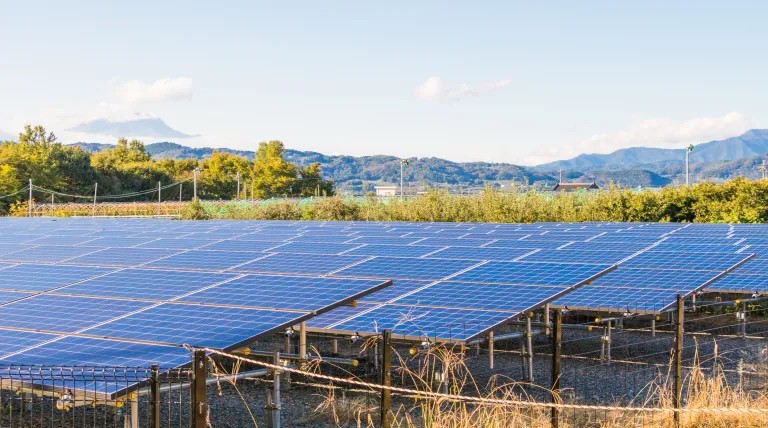
Renewable technologies generated a total of 13,259 GWh this May – 3.2% more than in the same month last year – and accounted for 60.5% of the total. Solar photovoltaic led production for the second consecutive month, reaching 6,254 GWh and securing a 28.5% share – the highest recorded to date.
Furthermore, 29 May saw the highest daily solar photovoltaic generation in history, totalling 269 GWh, which contributed 33.4% of the generation mix on that day.
The second technology in the May mix was nuclear, accounting for 17.1%, followed by wind at 14.8%, combined cycle at 13.6%, and hydro, which ranked fifth with 12.9%.
During the month of May, 77.7% of electricity generation was free from CO2 equivalent, representing a 7% increase in zero-emission GWh produced.
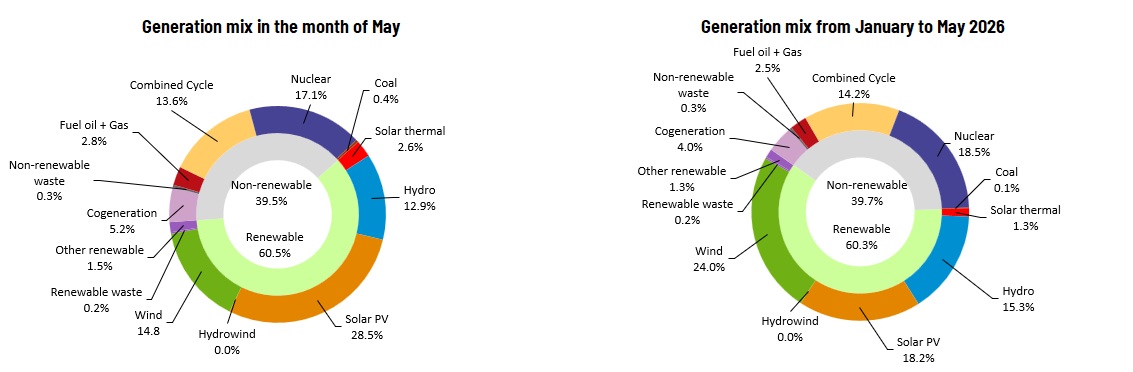
When accounting for electricity generation data from self-consumption installations, the renewable share of the Spanish mix rose to 62% in May, according to available estimates.
To promote greater utilisation of renewable generation, a total of 1,182 GWh was integrated into the grid in May through battery storage and pumped-storage hydro, which in turn supplied 489 GWh of energy back to the grid during the month. At the end of the month, these technologies held 693 GWh of stored energy.
The electrical system in Islas Baleares and Canarias
Electricity demand in Islas Baleares increased by 3.1% in May after adjusting for working patterns and temperatures. In gross terms, monthly demand is estimated at 494,445 MWh, 3.5% higher than in the same period last year. In the first five months of 2026, electricity demand in Islas Baleares stood at 2,301,697 MWh, 2.8% higher than in the same period of the previous year.
Regarding electricity generation, combined cycle, accounting for 64.1% of the energy produced in Islas Baleares, was the leading generation source on the islands this month, followed by solar photovoltaic, which increased its generated MWh by 6.3% and represents 15.4% of the mix in Islas Baleares. Thus, renewable energy grew by 9.2% compared to the same period last year, reaching a share of 18.9% of the total generation in the archipelago.
During this fifth month of the year, the subsea link between the Peninsula and Mallorca helped cover 23.2% of electricity demand in Islas Baleares.
Turning to the Canarias archipelago, electricity demand grew by 7.8% compared to the same month in 2025, adjusting for working patterns and temperatures. In gross terms, demand stood at 764,993 MWh, 7.3% higher than in May of the previous year. For the year to date in 2026, Canarias recorded a demand of 3,665,764 MWh, 2.4% higher than in the same period of 2025.
Lastly, in terms of electricity generation, combined cycle was the leading source in Canarias in May, accounting for 39.3% of the total. Wind power accounted for 16.8% of the total, up 29.2% compared to May 2025, while solar photovoltaic grew by 29.6% to reach 58,008 MWh – a contribution representing 7.6% – marking the highest figures ever recorded on the islands.
Overall, during the fifth month of the year, renewable electricity generation in the archipelago reached a share of 24.4% of the total.
For more stadistical information about the electrical system, visit our Data section on the website.
Downloads