
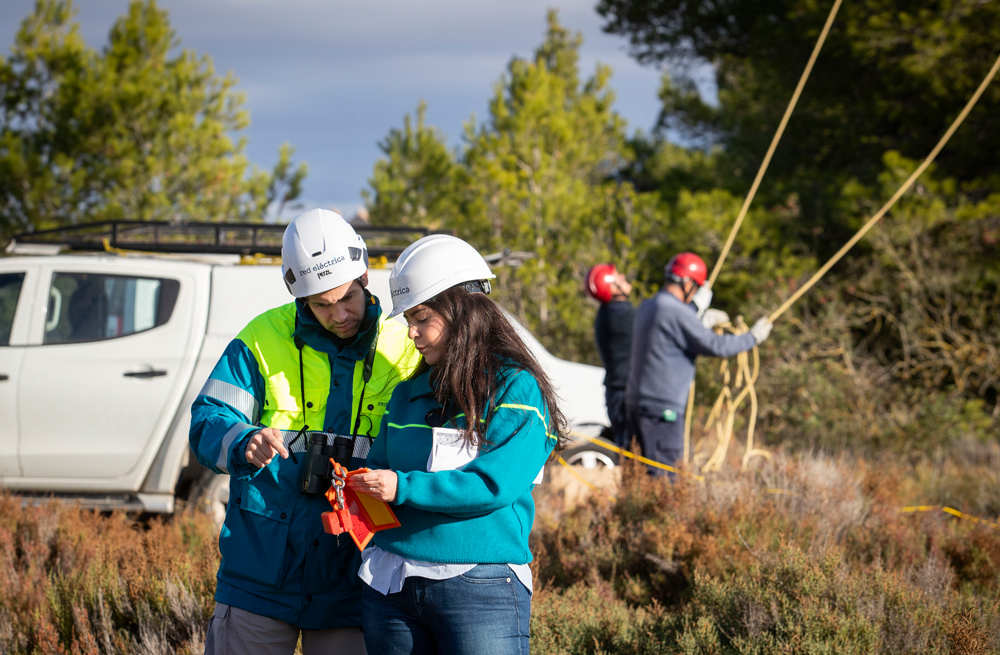
Discover what Red Eléctrica is, what we do, and why we are the backbone of the electricity system in Spain and the ecological transition.




Spain’s demand for electricity falls by 1.8% in March
Wind, hydro and solar photovoltaic lead the national generation structure, in which renewables as a whole accounted for 63.1%.
01/04/2026
National electricity demand fell by 1.8% in March compared to the same month last year, after adjusting for the effects of temperature and working patterns. In gross terms, demand reached 21,182 GWh, down 3.1% compared to March 2025. In addition, based on available data, it is estimated that self-consumption installations generated around 933 GWh during the month.
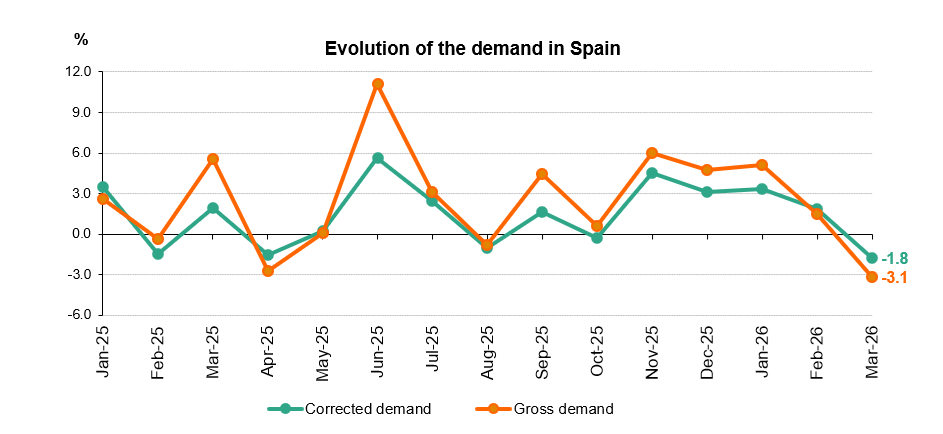
In the first quarter of the year, our country recorded a total of 65,835 GWh of electricity demand, representing an increase of 1.2% compared with the same period of the previous year. Taking working days and temperatures into account, this increase is also 1.2%.
Electricity generation
Renewable technologies generated a total of 14,484 GWh this March, representing a 63.1% share of the total —a figure similar to that achieved in February of this year. In March, 80.2% of electricity generation came from technologies that do not emit CO2 equivalent.
The top three sources in the national generation mix were all renewables. Wind led the way for the fifth consecutive month with 5,140 GWh (a 22.4% share), followed by hydropower, which saw a 5.9% increase over March 2025 to reach 19.2%. Solar photovoltaic grew by 36.7% and accounted for 18.5% of the month's electricity.
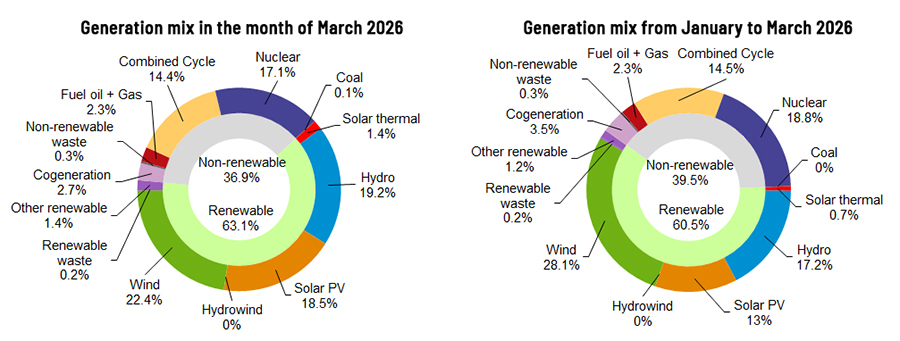
When accounting for electricity generation from self-consumption installations, the renewable share of the Spanish mix rose to 63.8% in March, according to available estimates.
Regarding storage systems, energy storage technologies (batteries and pumped storage) contributed a total of 938 GWh to the grid this month, enabling more efficient use of renewable energy generation.
The electricity system in Islas Baleares and Islas Canarias
Electricity demand in Islas Baleares increased by 1.1% in March after adjusting for the effects of working patterns and temperatures. In gross terms, monthly demand is estimated at 464,935 MWh – 2.3% higher than the same period last year. In the first three months of 2026, electricity demand in Islas Baleares stood at 1,366,589 MWh, 2.5% more than in the same period of the previous year.
Regarding electricity generation, combined cycle was the leading source for the islands this month, accounting for 73.3% of the energy produced. Solar photovoltaic followed in second place, growing its generation by 25.3% to account for 11.8% of the regional energy mix. Accordingly, renewable energy generation grew by 22.1% compared to the same month last year, reaching a 15% share of the total.
It should be noted that a double daily record was set in Islas Baleares on 30 March: solar photovoltaic electricity generation reached 2,312 MWh, helping total renewables reach a new all-time high of 2,913 MWh.
Additionally, this March, the subsea link between the peninsula and Mallorca helped cover 22.6% of electricity demand in Islas Baleares.
Meanwhile, in Islas Canarias, electricity demand grew by 0.6% compared to the same month in 2025, after adjusting for the effects of working patterns and temperatures. In gross terms, demand stood at 748,105 MWh, 1.5% higher than in March last year. In the year to date for 2026, Islas Canarias have recorded a total demand of 2,196,194 MWh, 1.2% higher than in the same period in 2025.
In terms of electricity generation in Islas Canarias, combined cycle was the leading source in March, accounting for 38.6% of the total. This was followed by wind, which represented 22% of the overall mix.
The series of storms and low-pressure systems that affected the archipelago during March contributed to a 69.7% increase in renewable electricity generation, reaching a 26.8% share of the total Canarian mix. Specifically, wind power grew by 111%, reaching 164,427 MWh, while solar photovoltaic accounted for 4.5% of the mix.
Downloads