
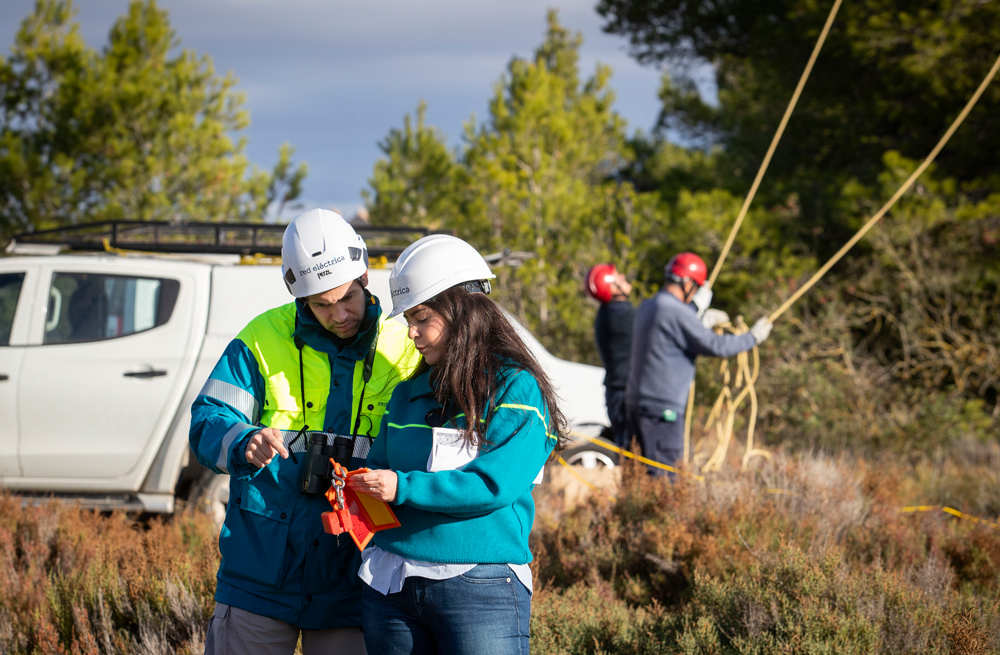
Discover what Red Eléctrica is, what we do, and why we are the backbone of the electricity system in Spain and the ecological transition.




Spain's electricity demand increases by 2% in January
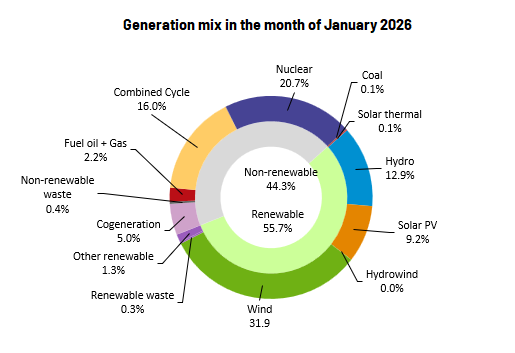
Renewable sources accounted for 55.7% of the month’s generation, a figure that rises to 56.1% when self-consumption estimates are included.
04/02/2026
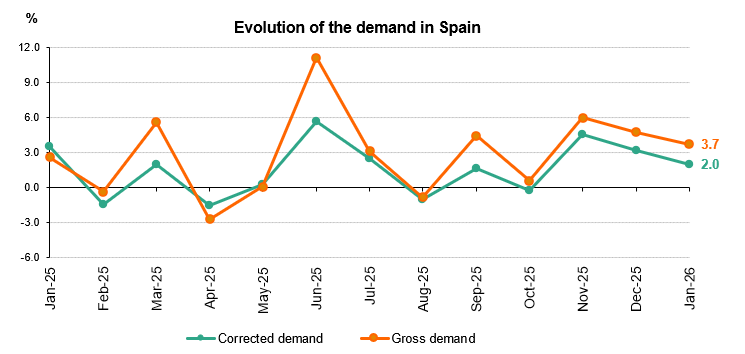
Spain’s national electricity demand rose by 2% in January compared to the same month last year, after adjusting for the effects of working patterns and temperature. In gross terms, demand reached 23,778 GWh, up 3.7% compared to January 2025. In addition, based on available data, self-consumption installations are estimated to have generated just over 700 GWh during the month.
Electricity generation
Renewable technologies generated 14,097 GWh this January, up 4.2% from the same month in 2025 and accounting for 55.7% of the total generation. In January, 76.4% of electricity generation came from technologies that do not emit CO2 equivalent.
Wind power was the leading energy source in January with a 31.9% share; it increased its output by nearly 7%, reaching 8,087 GWh. Nuclear and combined cycle ranked next, contributing 20.7% and 16% of Spain's total generation for the month. Hydro generation rose more than 4% compared to January 2025 —12.9% of the national total. Meanwhile, solar photovoltaic ranked as the fifth-largest technology with a 9.2% share.
When accounting for electricity generation from self-consumption installations, the renewable share of the Spanish mix rises to 56.1%, according to available estimates.
Energy storage technologies contributed 797 GWh to the grid in January, allowing for a more efficient use of renewable energy generation.
The electricity system in Islas Baleares and Islas Canarias
Electricity demand in Islas Baleares increased by 6.6% in January after adjusting for the effects of working patterns and temperature. In gross terms, monthly demand is estimated at 498,326 MWh —8.6% higher than the same period last year.
Combined-cycle generation accounted for 76% of the energy produced in Islas Baleares, making it the leading source in the region this month. Renewable energy generation represented 9.9% of the Balearic mix, reaching a 13% share when factoring in self-consumption installations. Additionally, this January, the subsea link between the Peninsula and Mallorca helped cover 27.8% of the islands' electricity demand.
On the other hand, electricity demand in Islas Canarias increased by 1.5% compared to the same month in 2025, after adjusting for the effects of working pattern and temperature. In gross terms, demand stood at 770,252 MWh, 1.8% higher than in January of the previous year.
In terms of electricity generation, the combined cycle was the leading source in January with a 44.3% share of the total. Renewable energy generation rose by 2.3% this month, accounting for 17.2% of the total —a figure that rises to 18.6% when including self-consumption estimates.
Downloads