
Discover what Red Eléctrica is, what we do, and why we are the backbone of the electricity system in Spain and the ecological transition.



Scientific seminar in La Línea
A study by the University of Seville with the support of Red Eléctrica contributes to transforming the ‘invasive seaweed’ on our coasts into a circular economy resource
- The study concludes that, through its treatment as waste, the Rugulopteryx okamurae seaweed can become a biofertiliser for agricultural use.
- Red Eléctrica, as part of its commitment to the province of Cádiz, supports this scientific research initiative to protect the marine environment and the fishing sector.
04/12/2025
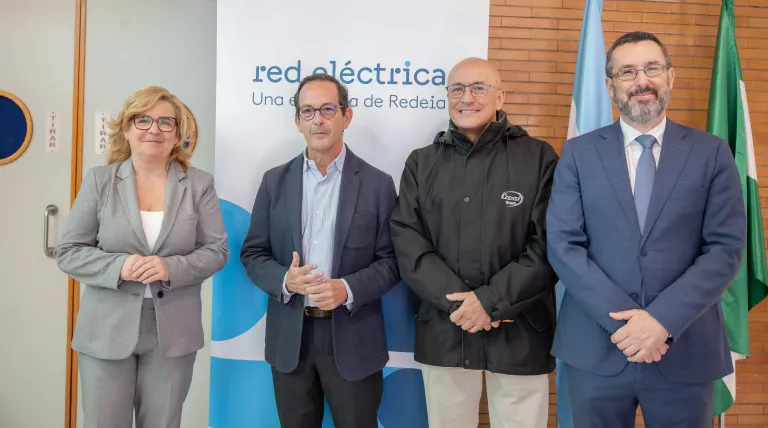
This Thursday, Red Eléctrica and the University of Seville presented the results of a scientific study launched in 2019 to analyse the impact of the invasive seaweed Rugulopteryx okamurae on the coastline of the province of Cádiz, and to investigate possible solutions to convert the biomass of this beach-cast seaweed into a valuable resource for the circular economy.
The conclusions of this work lay the foundations for the potential deployment of composting farms that use invertebrates to process and exploit this invasive species – which is causing severe damage to the marine ecosystem of the Strait of Gibraltar and its economic activity – as a resource.
The presentation took place this Thursday in La Línea de la Concepción during an environmental seminar led by the director of the Marine Biology Laboratory of the University of Seville, Professor José Carlos García-Gómez, and the researcher from his team, Enrique Ostalé. The presentation was also attended by Redeia's manager in Andalusia, Jorge Jiménez; the Mayor of La Línea de la Concepción, Juan Franco; the head of the La Línea Fishermen's Association, and other representatives of the municipal council, as well as environmental organisations.
The study originated within the framework of Red Eléctrica's work for the submarine electricity interconnection project between the Peninsula and Ceuta, a strategic project for the autonomous city and key to the decarbonisation of the Strait.
The support for this research is part of Redeia’s Comprehensive Impact Strategy, which seeks a positive impact on the territory with environmental and social projects and which has promoted 240 initiatives since 2022. These include the agreement with the Organisation of Artisanal Fishing Producers of the Conil Fish Market (OPP72) to undertake productive, competitiveness and energy-saving improvements in the Port of La Atunara.
Alliance with science and the sea
The University of Seville's study, which Red Eléctrica supports as part of its track record of commitment to biodiversity and particularly to marine ecosystems, evaluated the impact of this species in the Strait for the first time, evidencing significant damage to the resident benthic community (organisms living on the seabed) following its settlement.
After this first phase, which led to significant advances in the understanding of the species' ecology, the second phase began in 2022, approaching its study as a waste product given the enormous volume of biomass deposited annually on the beaches, which prevents its prior treatment. Under this premise, the scientists, in collaboration with the University of Extremadura, have proposed possible solutions such as composting it using crustaceans and insects, such as cockroaches of the genus Eublaberus and the black soldier fly. This composting makes it possible to reduce the toxicity of the seaweed when mixed with organic waste, producing a biocompost of acceptable quality and a certain salinity.
Furthermore, the use of the Eublaberus sp. cockroach as a composting element is emerging as a viable alternative on an industrial scale, favouring not only the reduction of waste, but also the production of more economical organic fertilisers.
Likewise, within the framework of the study, blatticomposting and anaerobic digestion emerge as complementary methods, where the mechanical and thermal pre-treatment of the seaweed significantly improves the yield in the production of methane and biofertilisers. Additionally, terrestrial isopod crustaceans, such as Porcellio laevis, present a novel and promising approach thanks to their capacity to rapidly consume large quantities of biomass, reproduce easily and accumulate heavy metals, although the study specifies that further research is required to optimise their use.
Finally, it is worth highlighting the progress in research aimed at the production of biogas (in collaboration with an R&D&I project led by Dr. Rafael Borja, from the CSIC) and at obtaining compounds of potential interest to generate new functional and bioactive ingredients for the food, nutraceutical, cosmetic and pharmaceutical industries (in collaboration with a project led by Dr. Carmen Claro, from the Faculty of Pharmacy of the University of Seville), all framed within a circular economy model.
Thus, the scientific study establishes strategies that highlight the potential of transforming this invasive species, which generates an environmental problem, into an opportunity for the sustainable production of energy, biofertilisers and natural substances of pharmacological and biomedical interest, as well as in the food sector.
Red Eléctrica's support for this research responds to the company's commitment to the marine environment, biodiversity and science, as well as its support for the fishing sector and the territory. Redeia and its subsidiaries' proven track record of commitment to the ocean led to the launch in 2024 of the Bosque Marino (Marine Forest) platform, which promotes conservation and environmental education through passive and active restoration projects and initiatives, as well as the promotion of scientific research and environmental education.
Downloads