
Discover what Red Eléctrica is, what we do, and why we are the backbone of the electricity system in Spain and the ecological transition.




Demand for electricity in Spain increases by 1.2% in February
Renewable sources accounted for 63.2% of the month’s generation, a figure that rises to 63.8% when self-consumption estimates are included.
03/03/2026
Spain’s national electricity demand rose by 1.2% in February compared to the same month last year, after adjusting for the effects of working patterns and temperature. In gross terms, demand reached 20,425 GWh, up 0.8% compared to February 2025. In addition, based on available data, self-consumption installations have generated 872 GWh during the month.
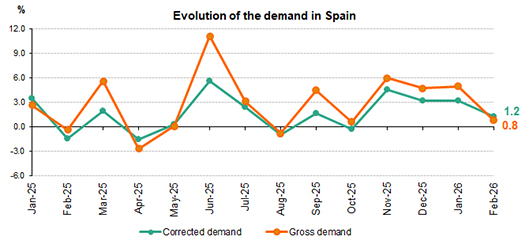
In the first two months of the year, our country recorded a total of 44,491 GWh, representing growth of 3% compared with the same period of the previous year. Taking working days and temperatures into account, this increase is 2.3%.
Electricity generation
Renewable technologies generated 13,654 GWh this February, up 17.1% from the same month in 2025, and accounting for 63.2% of total generation, one of the highest shares in history. In February, 81.8% of electricity generation came from technologies that do not emit CO2 equivalent.
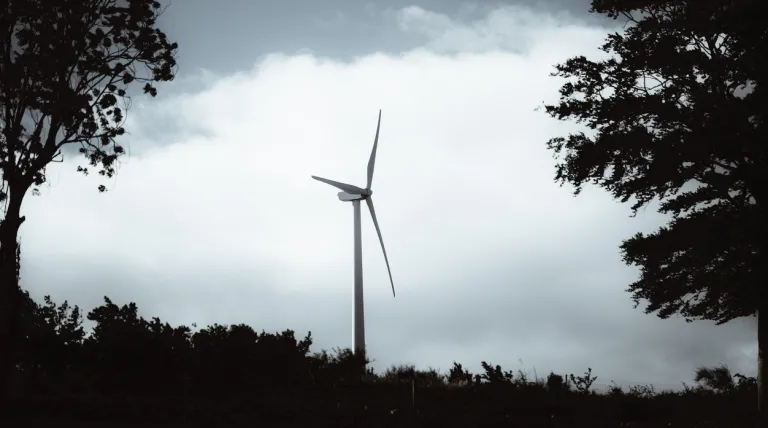
The successive storms that swept across the Iberian Peninsula during February meant that wind power grew by 68.3% compared with the same month last year, reaching 6,306 GWh. This technology, therefore, led the national generation mix in February with a 29.2% share.
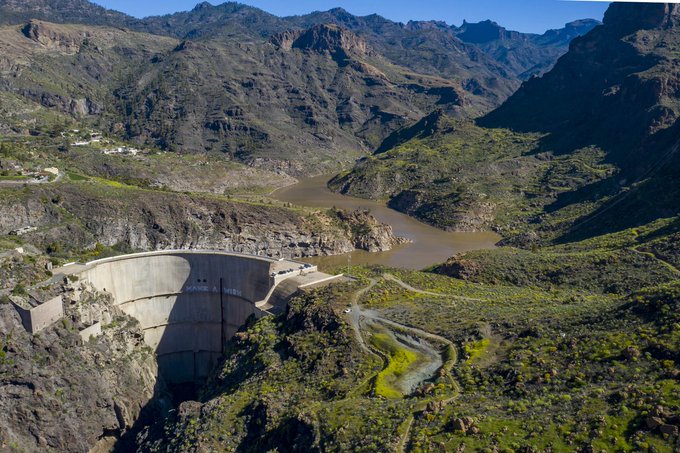
It was followed by hydropower, which produced 7.7% more than in February 2025, up to 4,451 GWh and a 20.6% share; nuclear, with 18.6%; combined cycle, with 12.7%; and solar photovoltaic, which accounted for 11.5% of the total.
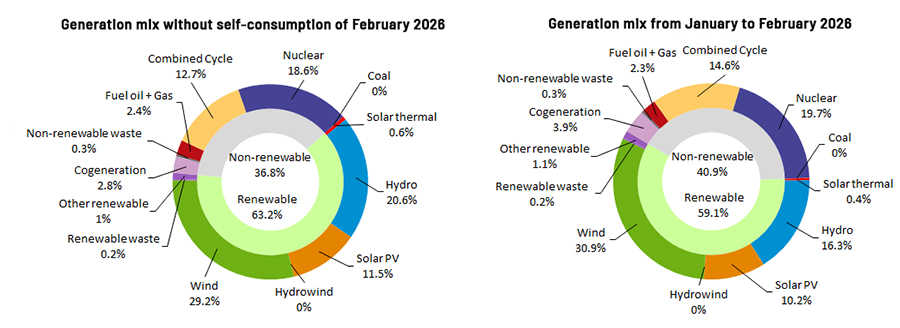
When accounting for electricity generation from self-consumption installations, the renewable share of the Spanish mix rises to 63.8%, according to available estimates.
As for storage systems, a total of 922 GWh from energy storage technologies (batteries and pumping) were integrated into the grid in February, allowing for greater use of renewable generation.
The electricity system in Islas Baleares and Islas Canarias
Electricity demand in Islas Baleares decreased by 3.5% in February after adjusting for the effects of working patterns and temperature. In gross terms, monthly demand is estimated at 397,741 MWh —5.4% higher than the same period last year. In the first two months of 2026, demand in the Balearic Islands was estimated at 898,801 MWh, 2.2% more than in the same period of the previous year.
As for production, combined-cycle generation accounted for 74.3% of the energy produced in Islas Baleares, making it the leading source in the region this month. Renewable energy generation represented 14.5% of the Balearic electricity mix. Additionally, this February, the submarine link between the Peninsula and Mallorca helped cover 25.8% of Islas Baleares’ electricity demand.
Meanwhile, in Islas Canarias, electricity demand fell by 0.1% compared to the same month in 2025, after adjusting for working patterns and temperatures. In gross terms, demand stood at 675,024 MWh, 0.3% lower than in February last year. In the aggregate for 2026, Islas Canarias recorded a total demand of 1,444,882 MWh, 0.8% higher than in the same period of 2025.
In terms of electricity generation, the combined cycle was the leading source in February, accounting for 42.7% of the total. Renewables generated 18.7% of all electricity in Islas Canarias.
Downloads