
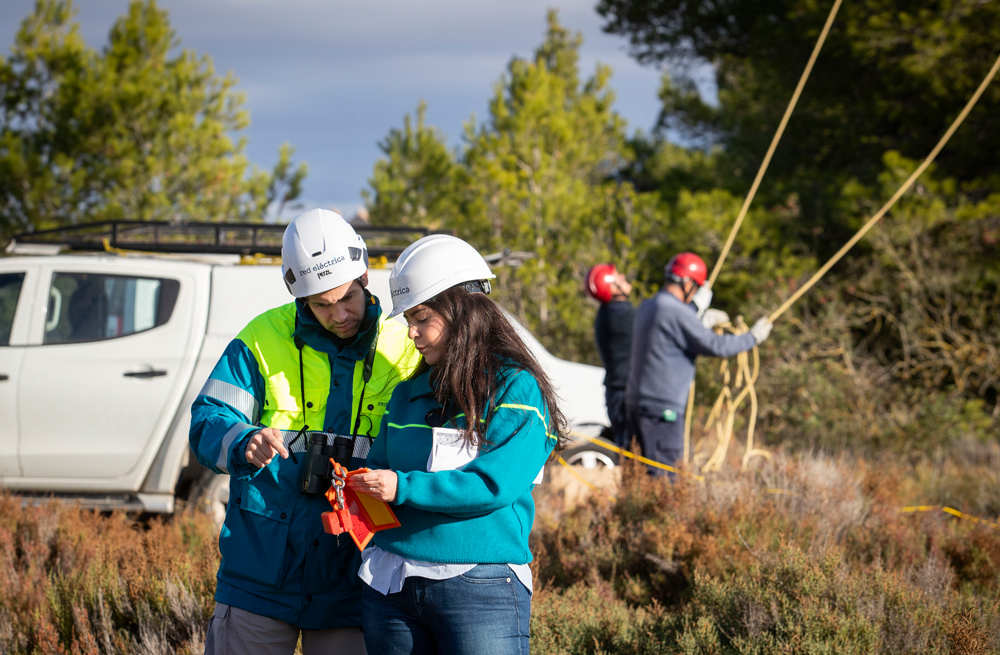
Discover what Red Eléctrica is, what we do, and why we are the backbone of the electricity system in Spain and the ecological transition.




According to Red Eléctrica forecasts
Electricity demand in Spain is set to continue its growth trend in 2025
Demand increased by 2.6% compared to 2024. After adjusting for working patterns and temperatures, the rise amounts to 1.4%.
Wind power remains the leading source of electricity generation for the third consecutive year. Meanwhile, solar photovoltaic reaches a new annual record, pushing the share of renewable energies to 56%, or 57% when including the estimated impact of self-consumption.
The highest demand on the peninsular electricity system was recorded on 15 January at 20:57, reaching 40,070 MW.
19/12/2025
Electricity demand in Spain could close 2025 consolidating its growth trend. According to Red Eléctrica estimates based on data available as of 16 December, national electricity consumption is expected to rise for the second consecutive year. Specifically, it is expected to increase by 2.6% compared to 2024, or 1.4% after adjusting for working patterns and temperatures. Overall, demand would total approximately 256 TWh. If electricity generated by self-consumption installations is included, demand would reach levels similar to those seen in the years prior to the COVID-19 pandemic.
Meanwhile, electricity generation from renewable sources is projected to increase by 1.6%, exceeding 151 TWh and once again surpassing the record values of 2024. In this context, the share of renewable energy would stand at around 56%, rising to 57% if the impact of self-consumption is considered. Spain would close the year with a share of nearly 75% of emissions-free electricity generation.
Based on provisional information available, wind power would once again lead the national energy mix, accounting for 22%. It is followed by nuclear and solar photovoltaic in that order, both with shares close to 19%. The latter technology sets a new annual record. Next come combined cycle plants, contributing nearly 17% of the total, followed by hydropower (12%) and cogeneration (almost 6%).
Coal, which was already a residual electricity generation technology, is expected to close the year with the lowest share and electricity generation in Spain’s history. It would contribute just 0.6% of the total, a reduction of more than 50% compared to the previous year. This is mainly due to the conversion of the Aboño II thermal power plant (in Asturias) to a steam turbine, which took place in mid-July.
Red Eléctrica’s forecasts also indicate that storage technologies, such as pumped storage plants or grid-connected batteries, have enabled the integration of around 9.4 TWh into the Spanish electricity system this year, optimising the use of renewable energies.
Demand in the islands and electricity exchanges
The increase in national demand has also been felt this year in Islas Baleares and Islas Canarias, where adjusted demand rose by 3.9% and 1.1%, respectively.
On the other hand, based on data available through 16 December, the peak demand in the peninsular electricity system was recorded on 15 January at 20:57, when it reached 40,070 MW.
Regarding electricity exchanges with neighbouring countries, 2025 would mark the fourth consecutive year that Spain ends with a net export balance, up 26% compared to 2024 and reaching almost 13 TWh.
Almost 70% of installed capacity is renewable
Throughout the year, Spain's generation fleet has continued to evolve, progressively adding new renewable capacity. Although final year-end data are still pending, it already exceeds 93 GW, representing more than 68% of the country’s installed generation capacity. When including the impact of renewable self-consumption installations, renewable capacity rises above 100 GW and accounts for 70% of the national generation fleet. By technology, solar photovoltaic remains the leader, followed by wind power.
Downloads